Where does design sit now that everyone can design with AI?

AI can make a design in minutes. It can't decide what problem you're solving, or make people trust the answer. Here's where design sits now.
At our latest CPO breakfast, someone asked me a question so good I'm thinking of planting a stooge at every future event to ask it again. (Joking. Mostly.)
Here's the question: in a world where we all think we can use Claude to design, where does real UX design expertise come in?
It made me realise exactly what I think about design in the age of AI. It isn't really about whether designers are needed. It's about what makes people trust a product.
Because when I can tell something has been made with AI, I trust it less. I start wondering what else they rushed. I doubt I'm the only one.
Anyone can open an AI tool and have a screen in minutes. So what is design for now?
Short answer: AI has made it quick and cheap to make a design. It hasn't made it any easier to know what to design, or to make people trust it. That's where design expertise sits now: working out the problem, keeping the experience clear, and making your product feel like yours.
Design was never about the pixels
Some businesses still see designers as pixel pushers. I understand why, because screens are the part everyone can see.
But the real skill is asking why. What problem are we actually trying to solve here? That question was always the valuable bit. AI has just made it impossible to ignore, because everything after it is now so much quicker.
Nielsen Norman Group says something similar in its State of UX 2026 report. It argues the interface is becoming less of a differentiator. Design systems have made UI cheaper to produce, and AI now handles more of what people do on top of the screen.
Its blunt point is that if all you do is piece together components, AI can already replace you. Taste, research and judgement are much harder to automate.
Designers see it the same way. In the State of AI Design 2026 report, around 60 to 70 per cent said they still rely on their own judgement, not AI. That covers things like understanding user needs and defining the problem.
So the work hasn't gone away. It has moved. Our focus with clients has shifted towards helping them figure out what to do, because working out how to do it is so much faster now. We've written before about why product design gets treated as a nice to have, and it's the same misunderstanding.
"It's cheaper to ship, so we'll just roll it back"
I hear this a lot, and I disagree with it.
Yes, it's cheaper to put something live. But every experiment lands in front of real customers, and a product that keeps changing direction gets confusing for them. It confuses your own team too, because nobody has a clear direction.
In the conversations I've had over the last year, product leaders are stuck between two kinds of pressure. Their teams are excited and want to experiment. Their CEO or board has seen other businesses talking about AI and wants to know why they aren't. Some businesses end up overwhelmed, with everyone pulling in a different direction.
Rolling back isn't free. In July, HubSpot switched all its customers into an AI feature that pooled their data by default. Customers pushed back within days, with some saying they'd look at other providers. HubSpot reversed the whole thing in four days, and its product chief called it a mistake. The feature was gone quickly. I suspect the question it raised in customers' minds took a lot longer to go away.
Speed makes this worse. NTT DATA points out that faster building cuts both ways. A weak product decision used to hide behind months of development, and now AI exposes it almost straight away.
NN/g reckons 2026 is shaping up to be the year of AI fatigue. Users are tired of lazy AI features, and teams are tired of being told to ship AI because a competitor did. We cover the risk side in AI is accelerating product development, but without design it's accelerating risk.
When everything starts to look the same
A lot of our work is in B2B SaaS, and there's a point where products start to look alike. Some of that is good. People build up mental models of how software works, so familiar patterns and classic components help them get started.
The question is when it goes too far.
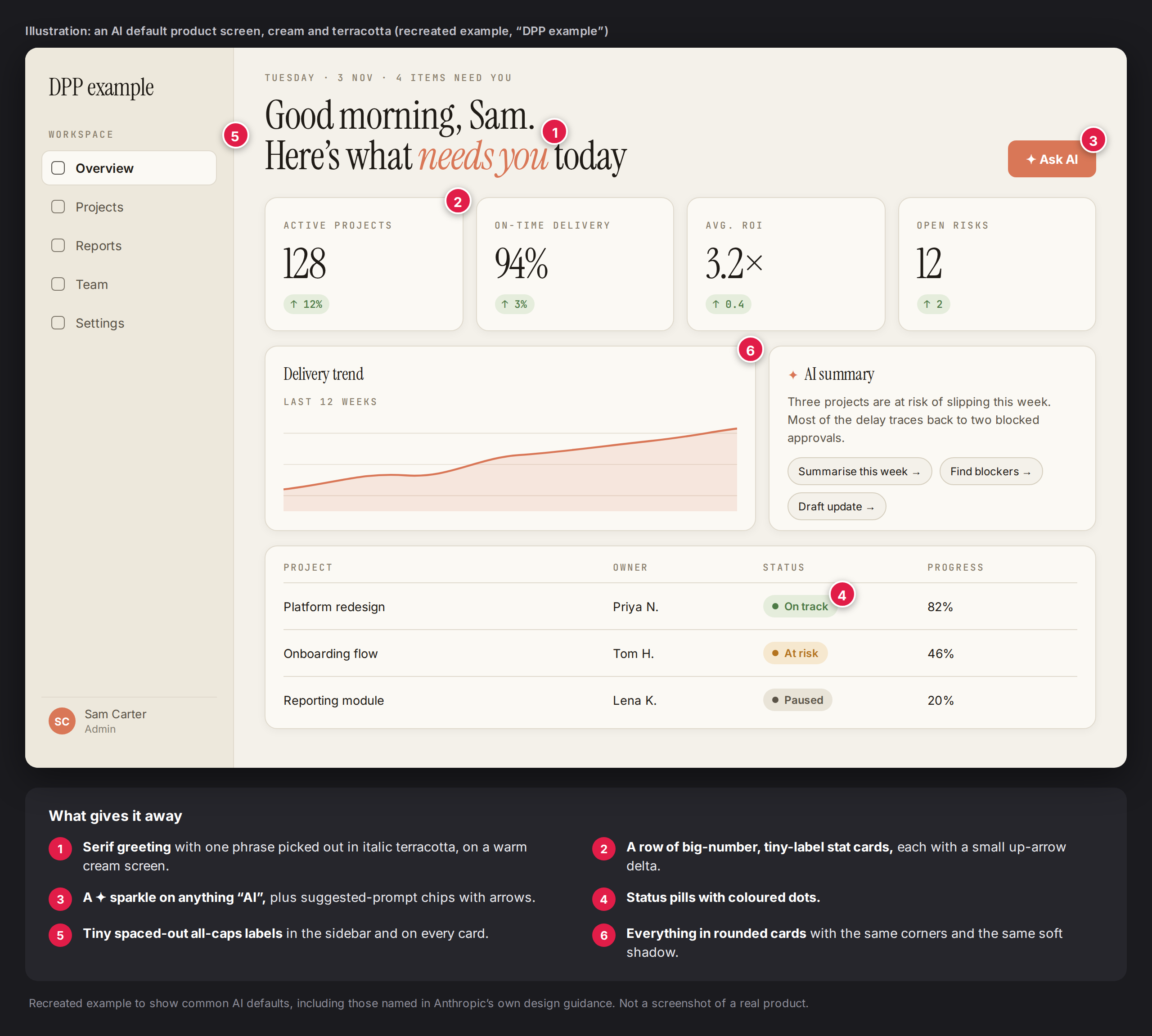
If you've spent any time looking at AI-made products, you'll know the look. Right now, a lot of them go like this: a warm cream screen, a big serif greeting with one phrase picked out in italic orange, a row of big numbers with tiny spaced-out labels, a ✦ sparkle on anything that's AI, and everything sitting in the same rounded cards.
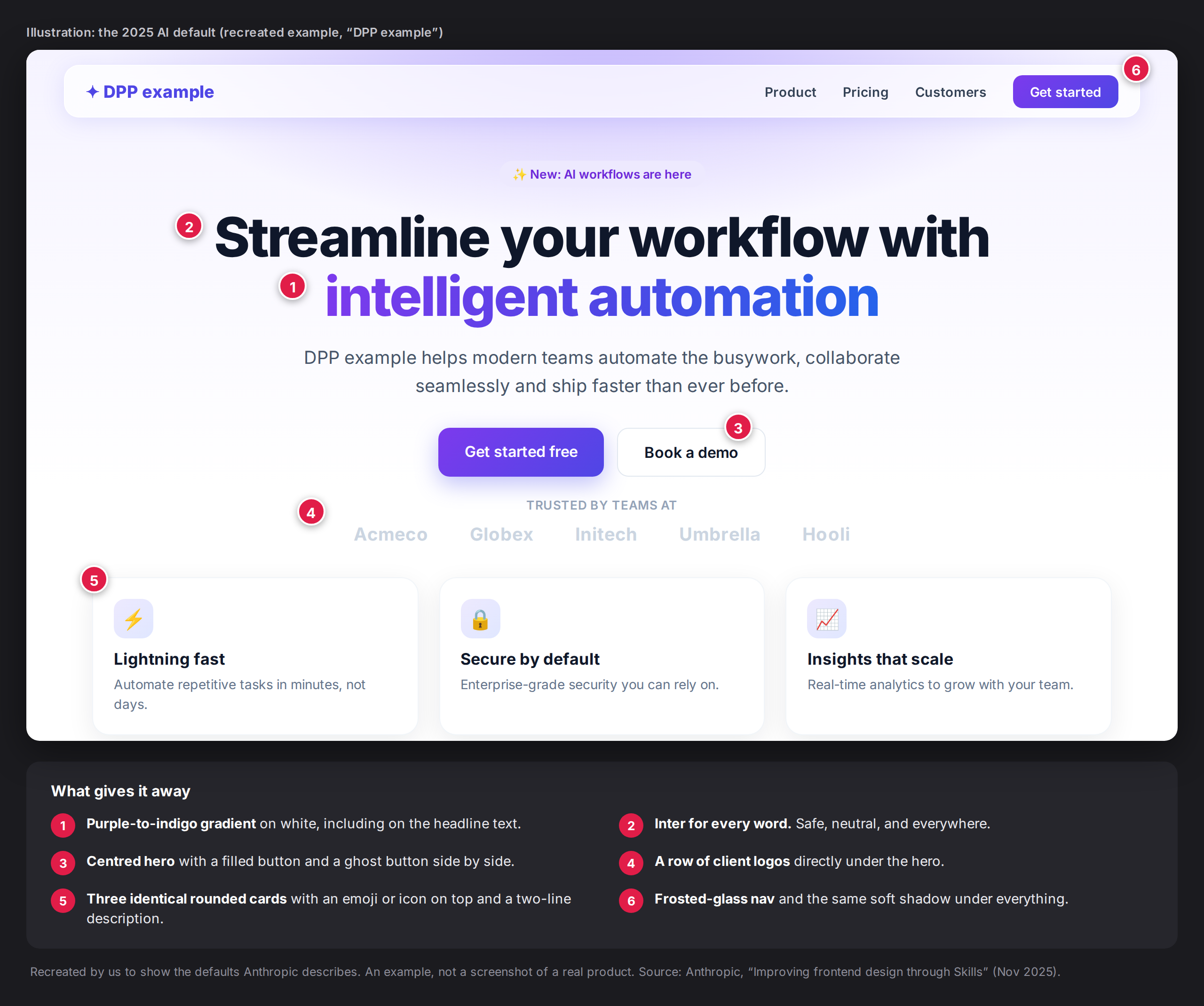
It was different a year ago. Websites and apps went for purple gradients, Inter for every word, a centred headline with two buttons, and three identical rounded cards.
Anthropic doesn't hide this. It says that without direction, its models drift towards the most common choices on the web, and it calls that distributional convergence. Its own design guidance now lists the cream-and-orange look, and a near-black look with a bright green accent, as defaults to avoid. That orange is close to the one Claude itself uses, which is why it gives the game away on someone else's product.
Notice how fast the tells move. The purple went out, the cream came in. The colour isn't the problem. Nobody chose it, and customers can tell.
Creative Bloq's piece on this describes AI as an "averaging engine". It gives you the most likely answer based on what it has already seen, and what it has seen is a web that was already narrowing. It uses SaaS as an example: the same typeface, the same hero section with a floating dashboard, the same headline about workflows and teams.
Someone in the room at our breakfast told a story that shows the risk. They had used Claude to mock up a solution to a complex problem, while a colleague did competitor research. The next day the colleague showed them what a big player in their sector was doing. It matched the mock-up almost exactly: the flow, the design, even the wording.
I don't know why that happened. But it fits what Creative Bloq describes, with tools reaching for the same most likely answer. And the reaction in the room was telling. As a customer, if you spotted that, you'd start questioning the other things that company does too.
Familiar is good. Identical is risky. If you're designing for complex products, there's a line between the two, and we wrote about how to simplify complex products without dumbing them down.
Trust is the new differentiator
Now that anyone can create a product and push it out, trust matters more. That's the risk for B2B products. If a buyer can tell your platform was made with AI and not much thought, they may start to wonder whether you have the budget, or the care, to do it properly.
So the job is to get trust across in the design itself. That's where brand and emotion come in. People's feelings about a product have always mattered, even in B2B. I'm a massive Monzo fan, and that goes back to my early experience of their brand, not a list of features. We explore the same idea in applying brand to product.
NN/g expects trust to be a major design problem in 2026, especially as AI agents get rolled out before they're ready. Its answer is the basics: being open about what the system is doing, giving people control, staying consistent, and supporting them when something goes wrong. That's the thinking behind our piece on designing AI for honesty, not illusion.
SaaS Capital, which lends to SaaS companies, tells a similar story from the money side. Across its own portfolio, it says it isn't seeing customers lost to vibe-coded alternatives in any meaningful way. Enterprise buyers ask the question, but nearly always stay with a provider they trust. Its view is that trust earned over time gets stronger with AI, not weaker. It's the same idea as a product moat.
Not everyone is this relaxed
It would be wrong to pretend everyone agrees. NTT DATA's view is tougher. It argues that a product manager can now have an idea on Tuesday and a working app by Friday. So heavy delivery models that sell hours, big teams and long discovery phases are hard to defend.
It says the roles most at risk are built on coordination and admin rather than expertise. Value moves to data, regulation, trusted brands and good judgement.
I think there's truth in that. The ceremonies around design and delivery can, and should, get lighter. But you can't skip the question underneath them. If anything, building faster means a wrong answer costs you more, sooner. NN/g adds a caution of its own: the market is still competitive, and entry-level roles are scarce.
Where people disagree is how fast things will change. Where they agree is that building is getting cheap and judgement isn't. We looked at how this is changing team roles in PM, designer or product builder?
How we use AI at DPP
We use it, and it helps. Here's where:
- Brainstorming at the start of a project
- Exploring UI, where we give it detailed instructions to go wild and create lots of variations, so we can show clients different routes and styles
- Prototyping quickly
- Spotting gaps in our thinking
- Turning designs into HTML code
There's plenty in between that we don't hand to it. The thinking stays with us: working out the problem, choosing the direction, and deciding what's right for the client.
What this means for product leaders
Here's what I'd do if I were in your seat.
1. Start with the problem, not the prompt
Before anyone opens a tool, write down the problem you're solving and what success looks like. Then give your team the freedom to explore different solutions. When everyone is working towards the same goal, you get much more value from the speed.
2. Let AI explore, and let people choose
AI is great at producing options quickly. It's poor at telling you which one is right for your users. Creative Bloq's advice is to use AI for the early exploring, not the finished product, and to start your references outside the algorithm, with books, film and other industries.
3. Make sure it feels like you
Put your product next to two competitors with the logos covered. Could someone tell which is yours from the flow, the wording and the tone, not just the colours? If not, you have brand and design work to do.
4. Look after the moments where trust gets made
Error messages, empty states, permissions, and how you explain what the product is doing. These are easy to skip when a design comes together fast, and they're where real users decide whether they believe in you. Test them with real people through user research, not just AI-generated feedback.
5. Give your teams one clear direction
Experiments are good. Experiments with no shared goal turn into noise for your team and your customers. Agree what you're trying to achieve, and let that decide which ideas go live.
Final thought
AI hasn't made design less important. It has made it easier to see which part matters. Making a screen is quick now. Working out what to make, and getting people to trust it, is the work. It always was.
Trying to work out where design fits as your team starts using AI?
We help B2B product teams get clear on the problem, keep their experience consistent, and build products people trust.
👉 Book a call with our team to talk about how we can help.
Are you wondering...
No. AI can generate screens and flows quickly, but it can't judge whether they work for real users in a complex product. Designers bring research insight, context and craft. Like smartphone cameras and professional photographers, AI lets anyone dabble. Serious products still need specialists.
Design now sits earlier than the screen. It's about finding the right problem, shaping a clear experience and building trust. AI speeds up making designs, so the value moves to deciding what to make and checking it genuinely works for real users.
AI picks the most likely answer based on what it has already seen, and the web is already full of similar designs. Without a clear point of view from your team, results drift towards the average. Creative Bloq calls this a copy-of-a-copy problem.
You can't be certain, but defaults give it away: a purple gradient or cream background, a big serif headline with one word in italic, a small all-caps label above headings, identical rounded cards, and numbered points that aren't steps. These show nobody made a decision. They don't prove AI was used.
Yes, for exploring options and speeding up the early stages. Keep people in charge of defining the problem, choosing between options and testing with real users. B2B products have complex workflows and expert users, so details AI misses can quickly cost you trust.
Be clear on who the product is for and what problem it solves, then let that show in the flow, wording and tone, not just the visuals. Familiar patterns help people get started. Distinctive choices in the details make you memorable and trusted.
Yes. When anyone can build and ship a product, buyers look for signs that a real team stands behind it. NN/g expects trust to be a major design challenge in 2026, and SaaS Capital says earned trust protects vendors from vibe-coded alternatives.
You'll see it in these signs:
✅ Every design decision traces back to a clearly stated problem
✅ Real users have tested it, and you've fixed what they struggled with
✅ Someone could tell your product from a competitor's with the logos covered
✅ Your team can explain the goal in one sentence
✅ Adoption and retention are moving the right way
More insights
The commercial gap in product management (and why AI makes it matter more)
PM, designer or product builder? How AI is reshaping product team roles
Need help delivering at pace whilst maintaining product integrity?
We help B2B product teams rebalance pace and purpose — designing workflows where speed serves strategy instead of undermining it. Book a call to talk about how we can help you deliver your product's vision.