The commercial gap in product management (and why AI makes it matter more)

AI has made building cheap, so the hard part is deciding what's worth building. Yet ask most product teams what their product needs to earn, and the room goes quiet.
The commercial gap in product management is simple. Lots of teams build great products without really knowing how those products make money. The gap has always been there, but AI has made it much harder to ignore.
When anyone can build quickly, the advantage goes to the people who can decide what is worth building. For product leaders in B2B software, that is as much a money decision as a product one.
What is the commercial gap in product management?
The commercial gap in product management is when a product team makes decisions without understanding how the product makes money: what it needs to earn, who it earns it from and what it costs to run.
Teams can usually tell you what their users need. They find it harder to tell you how that need turns into revenue.
It was one of the most voted-for topics at our CPO roundtable, which made me realise how common this is across businesses.
I am still surprised by how little people talk about KPIs. When we start working with a B2B product team, we ask what the product is measured on. We often struggle to get a clear answer.
The money side tends to be an afterthought. The brief is usually something like "the business wants it to make more money". It rarely drives the conversation.
I am not the only one who has noticed. Product coach Dave Wascha, quoted by Mind the Product, says he has met plenty of product people who can't explain how their company makes money.
Which commercial questions should every product team be able to answer?
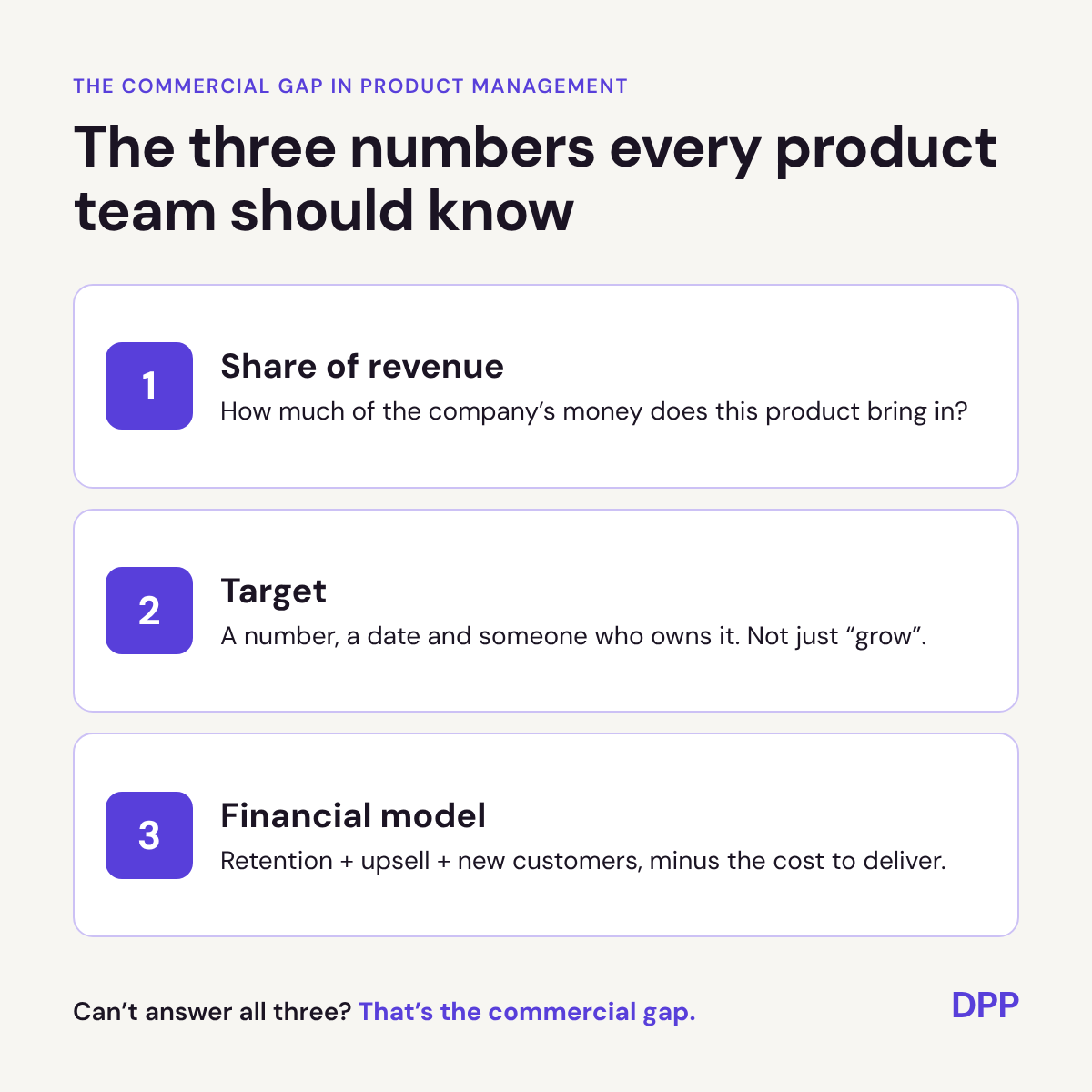
There are three. If your team can't answer them, that is the gap.
- How much of the company's revenue is this product? A product that brings in most of the company's money is a very different job from one that brings in a small slice.
- What are the targets? Not "grow". A number, a date and someone who owns it.
- What is the financial model for hitting them? How much will come from retention, how much from in-product upsell and how much from new customers? And what does it cost to deliver?
Here is what good looks like, using a made-up compliance reporting platform:
- Share of revenue: £6m of the company's £20m, so 30%.
- Target: £7.5m by December 2027, owned by the CPO.
- Financial model: £600k from better retention, £500k from upselling an analytics tier inside the product, and £400k from new customers.
- Cost to deliver: hosting and AI usage at around 18% of the product's revenue, rising with usage.
With those four lines, every roadmap conversation gets easier. A feature either moves one of those numbers, or it has to explain why it's there.
Charanya Kannan, a senior product director at Navan, has a simple way to think about it. Revenue comes from three things: how many users you have, how often they use the product, and the price you charge. Costs either stay the same or grow as usage grows.
The trick is working out which of those matters most for your business. Then make sure the way you charge matches it.
She also says lots of product managers focus on getting more people to sign up, without checking whether that brings in more money. In B2B SaaS, she argues, it often isn't what matters. It's one reason product-led growth works differently in B2B.
In our experience, the money side of B2B SaaS usually comes down to a few things. Making the product easier for sales to sell. Keeping customers. How quickly people get value. And whether they actually use it.
They don't get the attention of a shiny new feature. They should.
Why is there still a commercial gap in product management?
There isn't one simple reason. A few things add up.
Product grew up on the delivery side. Roadmaps and user stories became the craft, and for lots of product managers revenue was never really part of the job. Mind the Product points out that many come from engineering or design.
Shweta Doshi, Head of Product at Mindtickle, goes further. She argues product management started out as a commercial role. As products got more complex, it drifted towards delivery, and pricing, growth and go-to-market moved to other teams.
Either way, the result is the same. Many product managers are now expected to own numbers they were never asked to look at.
The money sits with someone else. Wynter surveyed 50 senior B2B SaaS leaders in April 2026. 62% said their company has no single owner for pricing. It is a small survey, but it tells you something.
Confidence plays a part. Corinna Stukan says people who have spent years focused on delivery can feel put off by business jargon. You don't need an MBA, she says. You need "business curiosity".
Timelines don't match. Product thinks three, six or twelve months ahead. Commercial teams want exact numbers sooner than honest product work can give them. We've written about balancing short-term decisions with long-term product strategy when that pressure builds.
Why does judgement matter more now that AI has made building cheap?
Because building is no longer the hard part. Deciding what to build is.
Rich Mironov has spent decades in product. He argues that building ten times faster doesn't mean ten times more revenue. Software budgets aren't growing tenfold, and customers can't take on ten times as many changes. Most products fail because of the market, not because the code was late.
His point is that the question has changed. It is no longer whether we can build it. It is whether we should, for whom, at what price and through which channel. That's the job of product discovery.
Good judgement means thinking critically. With so much possible now, the job is choosing, and being able to explain why. Turing College calls it the new scarce skill.
It also means remembering who is on the other end. We might be in tech, but we are still selling to people. And people are emotional.
LinkedIn's B2B Institute and Bain have researched how businesses buy, and it is far less about logic than we assume. The Drum's coverage reports that buyers care slightly more about being able to defend a purchase than about whether the product works.
I think that is why getting value quickly, and getting people to actually use the product, matters so much. If a buyer can point to clear results, it is much easier to justify renewing.
AI also shows up weak thinking. A polished document, a working prototype and a confident roadmap are all quick to make now. Knowing which ones are worth acting on isn't.
We see this with AI features too. Decisions are often driven by a board worrying about what competitors are doing, not by a clear case for the business. Our checklist for deciding whether to add AI to your product is built around that.
Teams that can't link a decision to revenue don't slow down. They build the wrong thing faster. We wrote about that risk in why AI speeds up risk without design, and about the hidden cost of speed when everything is urgent.
It is also why we think AI makes specialists and good judgement more valuable, not less. We explored the people side in how AI is reshaping product team roles.
Why is the commercial gap bigger in B2B software?
Four things make it harder in B2B.
The buyer isn't the user. The person who signs the contract rarely logs in. The value has to make sense to one of them in numbers, and to the other in daily use.
AI changes how you measure success. Keyuri Anand of Clio argues that if one person becomes ten times more productive, you sell fewer seats. She says retention is better measured by accuracy than by logins. James Colgan adds that in AI products "your most engaged user could end up being your most expensive one". Both spoke at Product-Led Alliance events.
That is a design question as much as a pricing one. If every interaction costs money, the product should help people finish their task quickly, not keep them chatting. It's where product management and UX design have to work towards the same business goals.
Pricing hasn't caught up. Product-Led Alliance says three in four SaaS companies have added generative AI features. Only around 15% are successfully charging for them.
AI tokens are also putting cost and pricing under the spotlight. When every interaction has a price, it stops being a question you can leave to finance.
Customers can only take on so much. Mironov points out that big customers already struggle to keep up with updates. Shipping faster doesn't help if they can't adopt what you ship.
How do you close the commercial gap in product management?
You don't need to turn product managers into accountants. You need to get into the habit of asking about the money.
- Ask for the three numbers. Talk to finance and leadership about the product's share of revenue, its targets and the financial model behind them. If nobody knows, that tells you something.
- Turn "make more money" into a target. Stukan says every business wants one of two things: more revenue or lower costs. Ask which number, by when, and what you are expected to do about it.
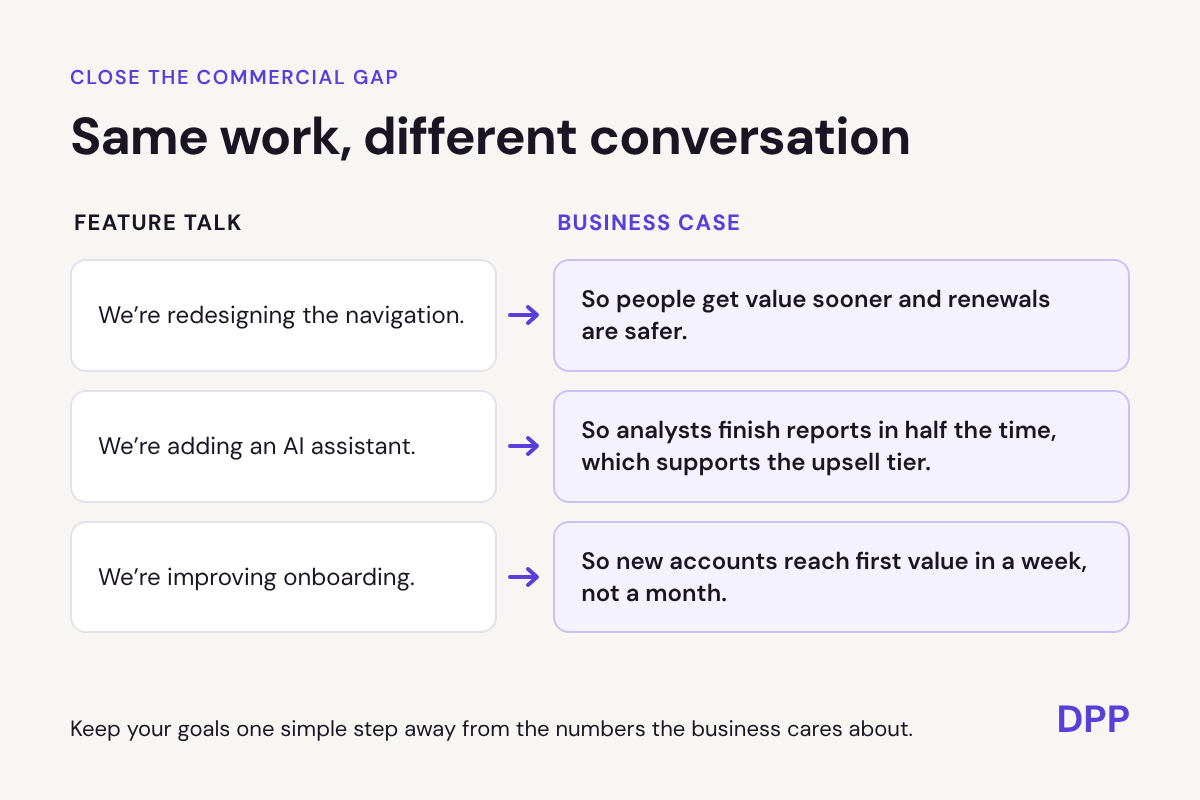
- Talk about your work in business terms. "We're redesigning the navigation to make it clearer" is a feature. "We're helping people get value sooner so renewals are safer" is a business case. Matt LeMay says your goals should sit one simple step away from the company's numbers. Our guide to proving the ROI of UX to your board shows how to make that case.
- Find out what each team is rewarded for. Kannan tells a story about a startup that rewarded support agents on customer satisfaction. They started waiving fees to keep people happy, and revenue dropped. Ask finance, sales and customer success what they are measured on. It's also the fastest way to build influence without authority.
- Don't chase perfect proof. Stukan points out that growth comes from lots of things, so a rough idea of your impact is fine. Balance instinct with evidence, and track meaningful signals, not vanity metrics.
What this means for CPOs and Heads of Product
If you are a CPO or Head of Product, closing the commercial gap is down to you. It won't close by itself.
- Know the revenue. Make sure everyone on your team can say how much revenue the product brings in, and what it is meant to deliver.
- Set real targets. Swap "make more money" for a target, a date and a financial model. Our piece on outcome over output is a good place to start.
- Give the unglamorous work airtime. Getting value quickly, adoption and keeping customers deserve as much time as new features.
- Ask for the business case early. Get it before a feature goes on the roadmap, not after it ships.
- Settle pricing ownership. Decide who owns pricing, and make sure product is in the room.
- Match authority to accountability. If you want product to own the numbers, give it the power to decide. Responsibility without it doesn't work.
- Remember buyers are people. Make the value easy to see and easy to defend.
- Reward good judgement. That includes the decision not to build something, and saying no to senior stakeholders when it's right.
Final thought
The commercial gap in product management isn't a people problem. The expectation has shifted. Product used to be judged on delivery, and now it is expected to understand the numbers too. AI has just taken away the cover that speed gave us.
The people who can connect product decisions to the numbers are the ones leaders trust with the big decisions.
There is good news. LeMay's research found that the most commercially minded product managers are also the happiest. They see their job as creating value for the business, not fighting it.
When building is cheap, knowing what to build, who it is for and how it pays its way is the real work.
Struggling to link your product decisions to the numbers the business cares about?
We help B2B product teams work out what is worth building, who it is for, and how to show the value. 👉 Book a call with our team to talk about how we can help.
Are you wondering...
The commercial gap in product management is when a product team makes decisions without understanding how the product makes money. The team knows what users need, but can't say what the product must earn, who from, or what it costs to run. AI makes the gap more costly, because teams can now build the wrong thing faster.
Commercial acumen in product management means understanding how your business makes and spends money, and using that to make product decisions. It covers revenue, pricing, costs and go-to-market. It helps product managers back what they build with a business case, not just what users say they need. Mind the Product explains why it's now essential.
Mostly because of how the job grew up. Many product managers come from engineering or design, and pricing and go-to-market often sit with finance or sales. Business jargon can also feel off-putting. None of it is permanent. Commercial thinking can be learned on the job, and you don't need an MBA to start.
A product manager should be able to answer three questions. How much of the company's revenue does the product bring in? What are its targets, with a number, a date and an owner? What is the financial model for hitting them, across retention, upsell, new customers and cost to deliver? If a team can't answer these, it is guessing.
No. Business curiosity matters more than a qualification. Ask how money comes in, what the biggest costs are and where the company is investing. Reading the annual report or investor update, and talking to finance, sales and customer success about what they're measured on, will take you most of the way.
Product should have a strong voice, and in fast-moving AI products many experts argue it should lead. Chargebee's Prittam Bagani says pricing must evolve as fast as the product, and only product knows what it can do today. Pricing still involves finance, sales and leadership. What matters most is that someone clearly owns the decision.
AI has made building faster and cheaper, so speed no longer separates good products from bad ones. The hard part is deciding what is worth building, for whom and at what price. Good judgement, grounded in how the business makes money, stops teams building the wrong thing faster and helps them explain every decision.
You'll see money questions come up in everyday product decisions, not just in board presentations.
✅ Everyone on the team can say how much revenue the product brings in
✅ Every product has a target with a number, a date and an owner
✅ There is a financial model covering retention, upsell, new customers and cost to deliver
✅ Getting value quickly, adoption and keeping customers get airtime in roadmap discussions
✅ You can point to something you chose not to build, and explain why
More insights

PM, designer or product builder? How AI is reshaping product team roles
Need help delivering at pace whilst maintaining product integrity?
We help B2B product teams rebalance pace and purpose — designing workflows where speed serves strategy instead of undermining it. Book a call to talk about how we can help you deliver your product's vision.