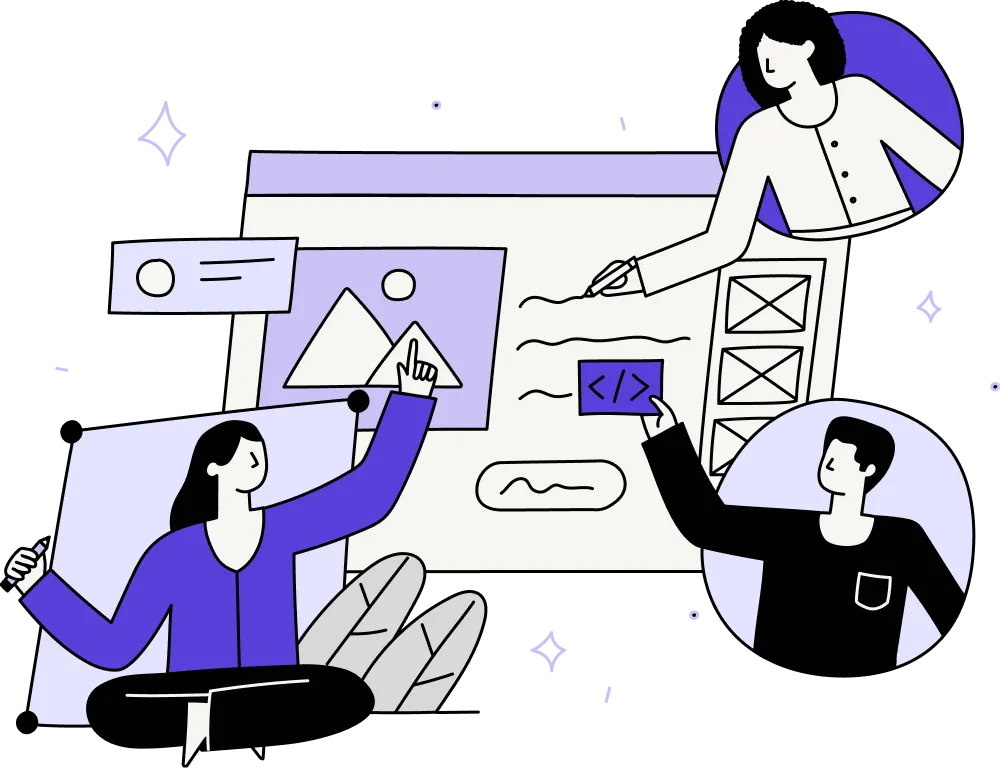
PM, designer or product builder? How AI is reshaping product team roles

Is AI merging product managers and designers into "product builders"? Our view: no. Here's why specialists matter more, and what CPOs should do now.
Scroll LinkedIn for five minutes and you'll be told the product manager is dead, the designer is next, and the future belongs to the "product builder": one person, armed with AI, doing the lot.
It's a tidy story. We don't buy it.
AI is reshaping product team roles, but not by merging them. It's raising the bar for specialists. The people who get the most out of AI are the ones who know their field well enough to tell when it's wrong.
Are PM and designer roles merging because of AI?
Short answer: no.
You're either a specialist or a jack of all trades. AI doesn't change that. What it changes is how much a specialist can get done.
Anyone can now ask AI to write a PRD, map a user flow or generate a screen. The output often looks convincing. But unless you're an expert in that field, you can't judge whether it's actually any good.
A designer can spot the flow that will trip up expert users. A PM can tell when a prioritisation rationale falls apart under commercial pressure. Without that expertise, you don't know what you're missing. It's why AI without design is accelerating risk, not just development.
That's the real shift. As a domain expert, AI makes you more valuable, not more replaceable.
Where the product builder role actually fits
The product builder, one person who blends product, design and engineering, isn't a myth. It just has a specific place.
It works in a startup, or a team lucky enough to have that rare person who genuinely understands all three. Their job is to get something to a point: a prototype, a proof of concept, a first version to put in front of customers.
What it doesn't do is deliver all the way through. Once you're building a complex B2B platform with multiple user types, compliance needs and a roadmap full of competing priorities, you need depth. One generalist, however well equipped, can't hold all of that.
Everyone has a great camera. We still hire photographers.
The most overhyped take right now is that we won't need designers or developers anymore.
Think about photography. Every iPhone has a fantastic camera. Anyone can take a decent photo, and billions of people do, every day. But when it really matters, like a wedding, a campaign or a product launch, people still hire a photographer.
AI is doing the same to product work. Anyone can dabble, and that's genuinely great. It lowers the barrier to trying out ideas. But for the top-tier work, the specialist still wins. If you're serious about the outcome, you bring in an expert. That's the same logic behind knowing when outsourcing product design is the right move.
The skills that matter more in an AI-powered product team
If you're a PM or designer wondering where to focus, here's our view:
- Get fluent in AI, fast. Use it for repetitive tasks and anything that means trawling through a spreadsheet. Spend the time you save on judgement calls.
- Keep your domain expertise sharp. It's what lets you challenge AI rather than simply obey it.
- Always ask for the source. If AI can't show where an insight came from, treat it as a hypothesis, not a fact.
- Stay on top of what's changing. The tools move month by month. Don't get left behind.
Just accepting whatever AI tells you is where things get dangerous.
How AI is changing user research (and where it isn't)
User research shows both sides clearly.
AI is brilliant at helping with analysis. Feed it your interview transcripts and it will surface themes in minutes rather than days. But it has real limits, as Nielsen Norman Group points out in its review of AI-powered UX research tools.
You can only use AI well if you were in those sessions. You'll already have a sense of the themes. You'll know the nuance: the hesitation before an answer, the body language, how someone said something, and what they didn't say at all.
That context lets you challenge AI and work with it to reach a balanced conclusion. Without it, you might run with whatever AI gives you, and head confidently in the wrong direction.
Once the research is done, make it work harder. Build a research repository your team can query, so anyone can ask "what do users think about onboarding?" instead of digging through old decks. We've written about how to make your user research evergreen, and AI makes that far easier. Just keep asking for the source behind every answer.
How AI is changing our own team at DPP
We're not writing this from the sidelines.
We're currently working alongside an AI sherpa at one of our clients, helping their teams adopt AI in a considered way. In our own research, AI has changed how we analyse, not why we research. We stay alert to our own biases, and to the ones built into AI models.
We also use AI to argue with us. We ask it to challenge our thinking, test our blind spots and offer a perspective we hadn't considered.
And we've been getting hands-on with vibe design and vibe coding platforms. That's partly to learn what genuinely makes tasks quicker, and partly to learn where we'd have been faster just doing it ourselves. Both lessons are worth having.
What CPOs and Heads of Product should do now
If you lead a product team, here's our advice:
- Give your team bandwidth and budget for AI. Experimentation doesn't happen in the gaps between sprints.
- Point it at a clear problem. AI is so powerful it can easily become a distraction. Anchor every experiment to your strategy and north star.
- Measure the impact. Decide what "better" looks like before you start, then check.
- Make it core, not a side project. AI belongs in your process and on your roadmap. Customers expect it to make your product more powerful. Your team expects it to make them more powerful day to day.
If you're still working out where to begin, read "We need AI in the product." Now what? and our 2026 report on AI in product.
Final thought
AI isn't erasing the lines between product managers, designers and developers. It's rewarding the people who know their craft well enough to use it properly.
Anyone can pick up the camera now. The people who know what they're looking at still take the best shots.
Want your product team to get real value from AI, without losing focus?
We help B2B product teams bring AI into their process and their products with clear direction and expert judgement. 👉 Book a call with our team to talk about how we can help.
Are you wondering...
No. AI is replacing parts of the product manager's workload, such as research synthesis, documentation and data lookups. The core of the role stays the same: judgement, prioritisation, and aligning stakeholders around customer value. PMs who use AI well will get more done. PMs who ignore it risk being left behind.
No. AI can generate screens and flows quickly, but it can't judge whether they work for real users in a complex product. Designers bring research insight, context and craft. Like smartphone cameras and professional photographers, AI lets anyone dabble. Serious products still need specialists.
A product builder is one person who combines product management, design and engineering skills, often using AI tools to build end to end. The role suits startups and early-stage teams that need to reach a prototype or first version quickly. It rarely scales to delivering complex B2B platforms long term.
Not in mature product teams. AI lets people produce work outside their specialism, but without expertise they can't judge whether that work is good. The bigger shift is that specialists who use AI become more valuable, because they can move faster while still spotting where AI gets it wrong.
Use AI for repetitive work: summarising research, drafting documents, analysing data and finding information quickly. Then spend the time you save on strategy, prioritisation and stakeholder decisions. Always ask AI for the source behind an answer, and never treat its output as fact without checking it against your own expertise.
Yes, AI can help identify themes across interviews and feedback far faster than manual analysis. But it works best alongside a researcher who attended the sessions and understands the nuance, including tone, hesitation and what went unsaid. Without that context, teams risk acting on AI-generated themes that point in the wrong direction.
You've got it right when AI makes your specialists sharper and faster, not just busier.
✅ Your team uses AI for repetitive tasks and spends the saved time on judgement calls
✅ Every AI experiment is tied to a clear problem and measured
✅ People routinely ask AI for sources and challenge its output
✅ Research insights are searchable across the team
✅ AI features appear on your roadmap because customers need them, not because of hype
More insights


Need help delivering at pace whilst maintaining product integrity?
We help B2B product teams rebalance pace and purpose — designing workflows where speed serves strategy instead of undermining it. Book a call to talk about how we can help you deliver your product's vision.