Should you add AI to your product? A business-value checklist for B2B product teams


Should you add AI to your B2B product? A six-checkpoint checklist for product leaders to test the user problem and business value first.
A B2B product is ready for AI when the team can show that AI solves a real user problem, creates clear business value, and does both better than the alternatives. Most teams skip that test.
The stakes are real. Gartner predicted in July 2024 that at least 30% of generative AI projects would be abandoned after proof of concept by the end of 2025. Its reasons were poor data quality, weak risk controls, rising costs and unclear business value. This checklist focuses on that last reason, and on the user problem behind it.
In B2B, the decision to add AI often starts with a board worried about competitors who are suddenly talking about AI in their product marketing. Meanwhile, teams under the CPO are excitedly building AI solutions to problems nobody has properly defined. These six checkpoints help you test the decision before you commit to it.
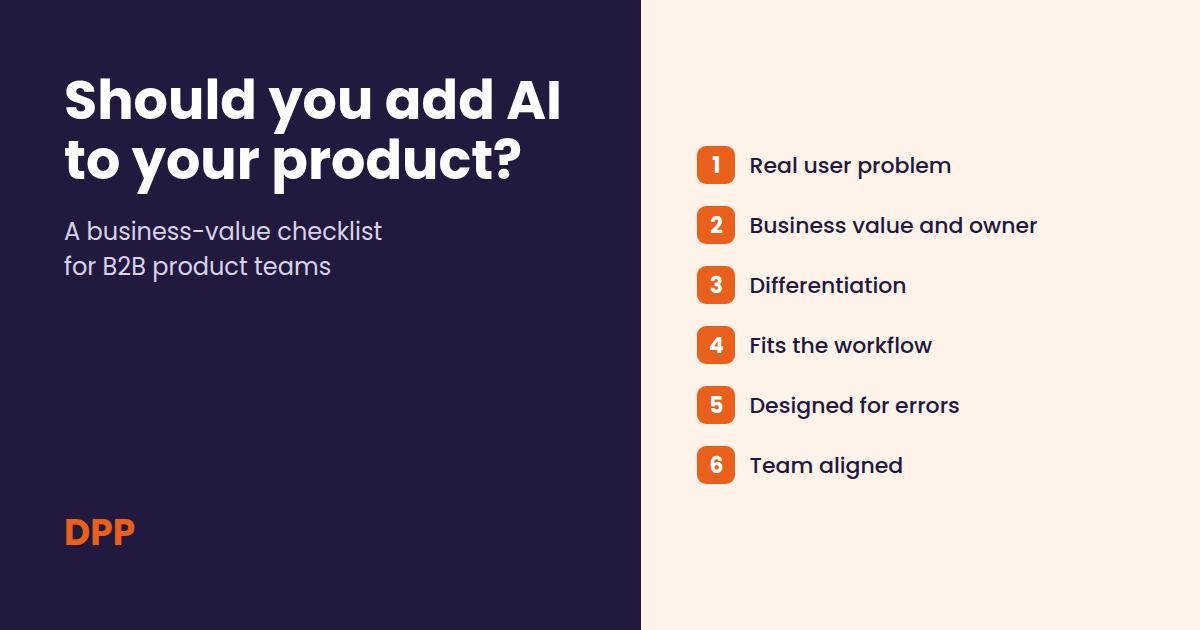
The AI checklist for B2B product teams: six checkpoints before you build
Work through these in order. If you can't answer the first two, stop there. Nothing else on the list will fix it.
1. Do you know which user problem AI solves, and is it a real one?
Start with evidence, not possibility. A real problem is one you've seen in user research, support conversations or sales calls, not one someone on the team suspects exists.
Google's People + AI Guidebook makes the same point. It suggests starting from the user need and asking where AI is genuinely well suited to meet it, rather than starting from "can we use AI to…?"
Here's the difference in practice. "Account managers spend every Monday morning reconciling three reports before client calls" is a user problem. "We should add an AI assistant to the dashboard" is a solution looking for one. If your evidence is scattered across old decks and support tickets, start by turning messy user feedback into actionable product bets.
Ready looks like: you can describe the problem in one sentence, in your users' words, without mentioning AI.
Red flag: the problem only makes sense because the solution is AI.

2. What business value will it create, and who owns delivering it?
Name the outcome you expect to move, and one person accountable for it. If you're unsure who that should be, it's worth understanding how AI is reshaping product team roles.
Then agree how you'll measure it before you build, in terms your users and your business would recognise: faster task completion, fewer support requests, higher adoption of a key workflow.
"AI launched" isn't an outcome. It's the output, and there's a big difference between outcome and output. AI initiatives without an owner or a measure tend to become experiments with no end point. Treat it like any other product experiment: a hypothesis, a measure and a date to review it.
For example, "cut the time to prepare a client report from 40 minutes to 10 within a quarter" gives you something to test. "Usage of the AI feature" doesn't, because it can climb while the business sees nothing. That's the gap between vanity metrics and meaningful product signals.
Ready looks like: a business outcome, a success measure, an owner and a review point are agreed before build starts.
Red flag: success means shipping.

3. Would this make your product more differentiated, or just match your competitors?
When every product page promises an AI assistant, AI on its own stops standing out. Ask whether this does something for your users that's hard to copy, something that draws on your domain expertise and your understanding of how your users work. That's what builds a product moat.
Matching a competitor can be a legitimate choice, if you're doing it knowingly, perhaps to protect renewals. It just shouldn't be mistaken for strategy. When the push comes from the board, it helps to know how to say no to senior stakeholders without damaging relationships, or at least "not yet".
Ready looks like: you can explain what's different about your approach, in a sentence a customer would recognise.
Red flag: the main justification is "they've got one".
4. Does it fit how your users already work?
B2B users are often experts working in complex workflows, and they're accountable for the decisions they make. An AI feature bolted onto a dense platform can add a step instead of removing one, and add to the hidden costs of complexity.
Look at where in the workflow AI would sit, what users would need to trust it, and who is responsible when it's used.
Picture a compliance analyst working through a queue of flagged transactions. AI that ranks the queue by risk, inside the screen they already use, removes work. A chatbot in a separate tab that they have to brief from scratch adds it.
If the product is already hard to use, fix that first. AI layered onto a confusing product just makes a faster confusing product. A UX audit will show you where to start, and there are ways to simplify complex products without dumbing them down.
Ready looks like: you've observed the real workflow and know exactly where AI helps.
Red flag: AI lives in a side panel nobody asked for.
5. Have you designed for when the AI is wrong?
AI gets things wrong, and it often sounds confident while doing it. Nielsen Norman Group describes this as hallucination: output that sounds plausible but isn't accurate.
In a B2B product, a wrong answer can end up in a report, a risk assessment or a client deliverable. I've written about why teams should design for honesty, not illusion.
In practice, that means showing where an answer came from, flagging where the system is less certain, and letting users edit the output before it goes anywhere. It also means making it easy to report a mistake, so the product gets better over time.
Ready looks like: users can see where an answer came from, check it, correct it and carry on.
Red flag: the only error state is "something went wrong".
6. Is the team aligned on why you're doing this?
Ask five people to write down, separately, why you're adding AI. Include someone from product, design, engineering, sales and customer success.
If you get five different answers, you're not ready. It's one of the clearest signs of product team misalignment, and AI tends to magnify it. The fix rarely needs another framework. It needs one agreed reason.
Ready looks like: everyone gives the same reason, in roughly the same words.
Red flag: the answers range from "efficiency" to "the board asked" to "it'll look good in the demo".

What your answers mean: ready, not yet, or not for us
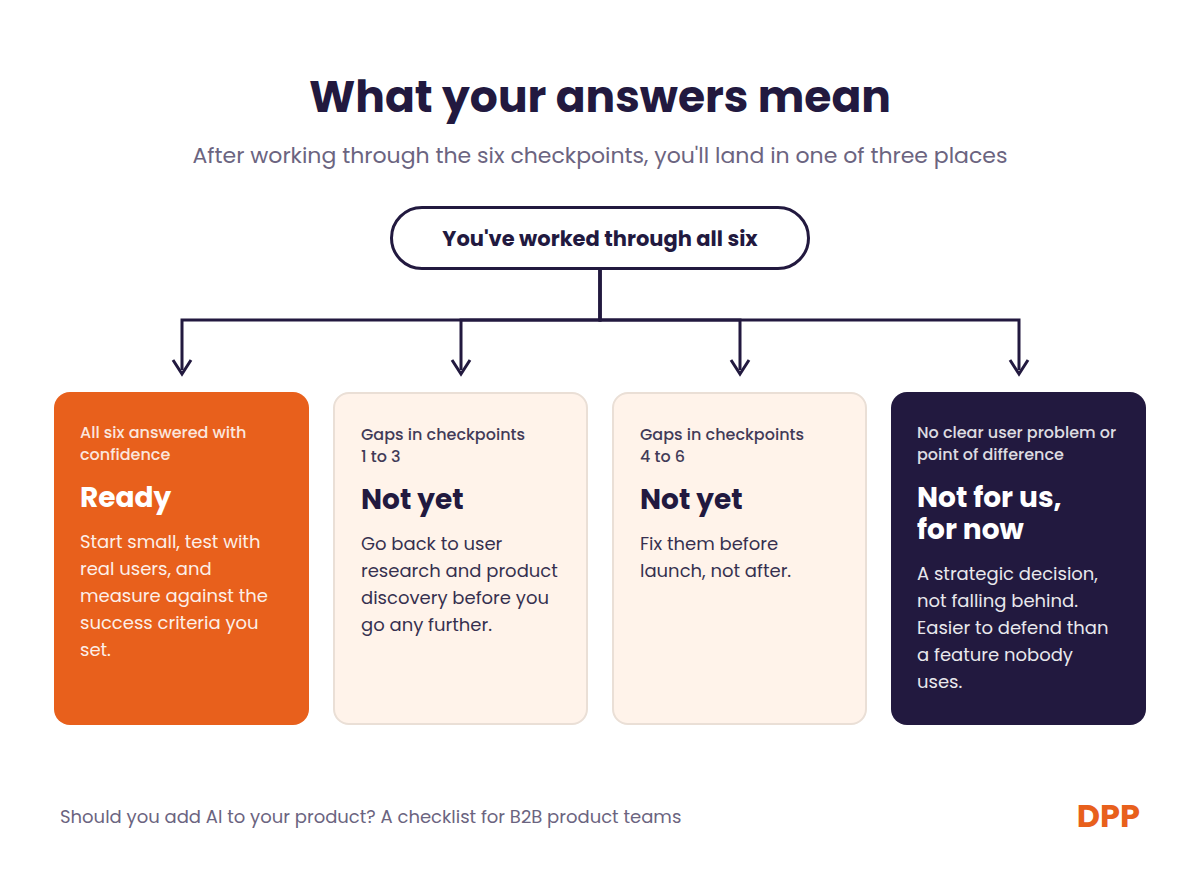
Once you've worked through the six checkpoints, you'll land in one of three places.
Ready. You can answer all six with confidence. Start small, test with real users, and measure against the success criteria you set.
Not yet. There are gaps. If they sit in checkpoints one to three, go back to user research and product discovery before you go any further. If they sit in four to six, fix them before launch, not after.
Not for us, for now. This is a legitimate answer. Choosing not to add AI yet is a strategic decision, not falling behind. A clear "not yet, and here's why" is far easier to defend to a board than an AI feature nobody uses.
Why the business case has to come before the technology
There are two forces at work in most organisations. There's fear at the top about how the business is perceived on AI. And there's energy lower down, with teams keen to explore what's possible.
Both are understandable. Neither answers the question that matters: what problem are we solving, and what is it worth?
I've written before about the pressure to add AI to the product and about how speed without design adds risk. It's also why we push teams to keep short-term AI wins in balance with long-term product strategy. This checklist is the practical follow-up: a way to test the decision before it becomes a project.
For a wider view of how product teams are approaching AI this year, read our 2026 report on AI in product.
Final thought
"We need AI in the product" isn't a strategy. "What are we trying to achieve, and is AI the right way to get there?" is.
- Start with a real user problem, not the technology.
- Define the business value and how you'll measure it before you build.
- Be honest about whether AI differentiates you or just matches competitors.
- Design for the moments AI gets it wrong.
- Treat "not yet" as a strategic answer, not a failure.
The teams that get the most from AI aren't the ones that moved first. They're the ones that knew why they were moving.
Under pressure to add AI, but not sure it's the right move for your product?
We help B2B product teams get clear on the user problems worth solving, test whether AI genuinely belongs, and move forward with confidence. You can see how in our work.
👉 Book a call with our team to talk about how we can help.
Are you wondering...
A B2B product is ready for AI when you can name a real user problem, show the business value AI will create, and explain why it beats the alternatives. You also need an owner, a success measure, a plan for when AI is wrong, and a team that agrees on why.
AI readiness in product strategy is how prepared a team is to decide whether, where and how AI belongs in their product. It covers user needs, business value, differentiation, user experience, ownership and alignment, so the decision rests on a clear reason rather than pressure.
Add AI when it solves a real, evidenced user problem and creates measurable business value you can name before building. If the main reason is that competitors have it, pause. Matching a competitor can be valid, but it should be a deliberate choice, not a reaction.
Ask which user problem AI solves, what business value it will create, and whether it would differentiate the product or just match competitors. Then ask how it fits users' workflows, what happens when it's wrong, and who owns it. Vague answers mean pause before building.
Yes. Deciding not to add AI, or to wait, is a legitimate strategic decision when there's no clear user problem or point of differentiation. Gartner lists unclear business value among the reasons it expected generative AI projects to be abandoned after proof of concept. A considered "not yet" is easier to defend.
One named person, often the CPO or head of product, should own the decision and its outcome, with design, engineering and data colleagues contributing. Without a single owner, AI work can drift into experiments with no end point. Agree success measures and a review point before building starts.
Design so users can see where an answer came from, check it, correct it and carry on. AI can produce confident but wrong output, known as hallucination, so show where the system is uncertain and give users clear ways to recover. A generic error message isn't enough in a B2B product.
Technically yes, but it's risky. Without research, teams build AI for problems they assume exist. Google's People + AI Guidebook recommends gathering evidence of user need before deciding whether to use AI at all. Even a small round of user interviews can show whether the problem is real.
Agree a business outcome and a baseline before you build, such as time to complete a key task, support volume or adoption of a core workflow. Then compare after launch against that baseline, not against usage of the AI feature itself. Usage can rise while the business sees no benefit.
You've done this well when the decision to add AI, or not, rests on evidence the whole team can explain. Look for these signals:
✅ You can state the user problem in one sentence without mentioning AI
✅ You can name the business outcome and how you'll measure it
✅ You can explain what makes your approach different from competitors'
✅ Users can spot, check and correct AI errors
✅ One owner exists, and everyone on the team gives the same reason for doing it
Slug: how-do-we-know-weve-done-this-successfully-ai-readiness
Two small edits to your answers: the Gartner FAQ now says "expected" rather than "expects", because the prediction's deadline (end of 2025) has passed. The success FAQ has a one-line lead before the ticks, so it reads as a full answer when an AI tool quotes it.
More insights

.png)
PM, designer or product builder? How AI is reshaping product team roles
Need help delivering at pace whilst maintaining product integrity?
We help B2B product teams rebalance pace and purpose — designing workflows where speed serves strategy instead of undermining it. Book a call to talk about how we can help you deliver your product's vision.