Now-next-later vs timeline roadmaps: which works for B2B product teams?

Now-next-later or timeline roadmap? Why dates erode trust, how to present a flexible roadmap to your board, and when a timeline still makes sense.
A product roadmap has two jobs: show where you're heading, and earn enough trust that people let you get there. Timeline roadmaps are good at the first and terrible at the second.
So when product leaders ask us whether a now-next-later roadmap or a timeline roadmap works better for B2B product teams, our answer is short. Choose now-next-later, with indicative timeframes and a clear line to business outcomes. Here's why, and how to make it land with the two audiences who matter most: your board and your customers.
Now-next-later vs timeline roadmaps: what's the difference?
A timeline roadmap plots features against dates, usually as a Gantt-style chart spread across months or quarters. It answers one question: "When will this ship?"
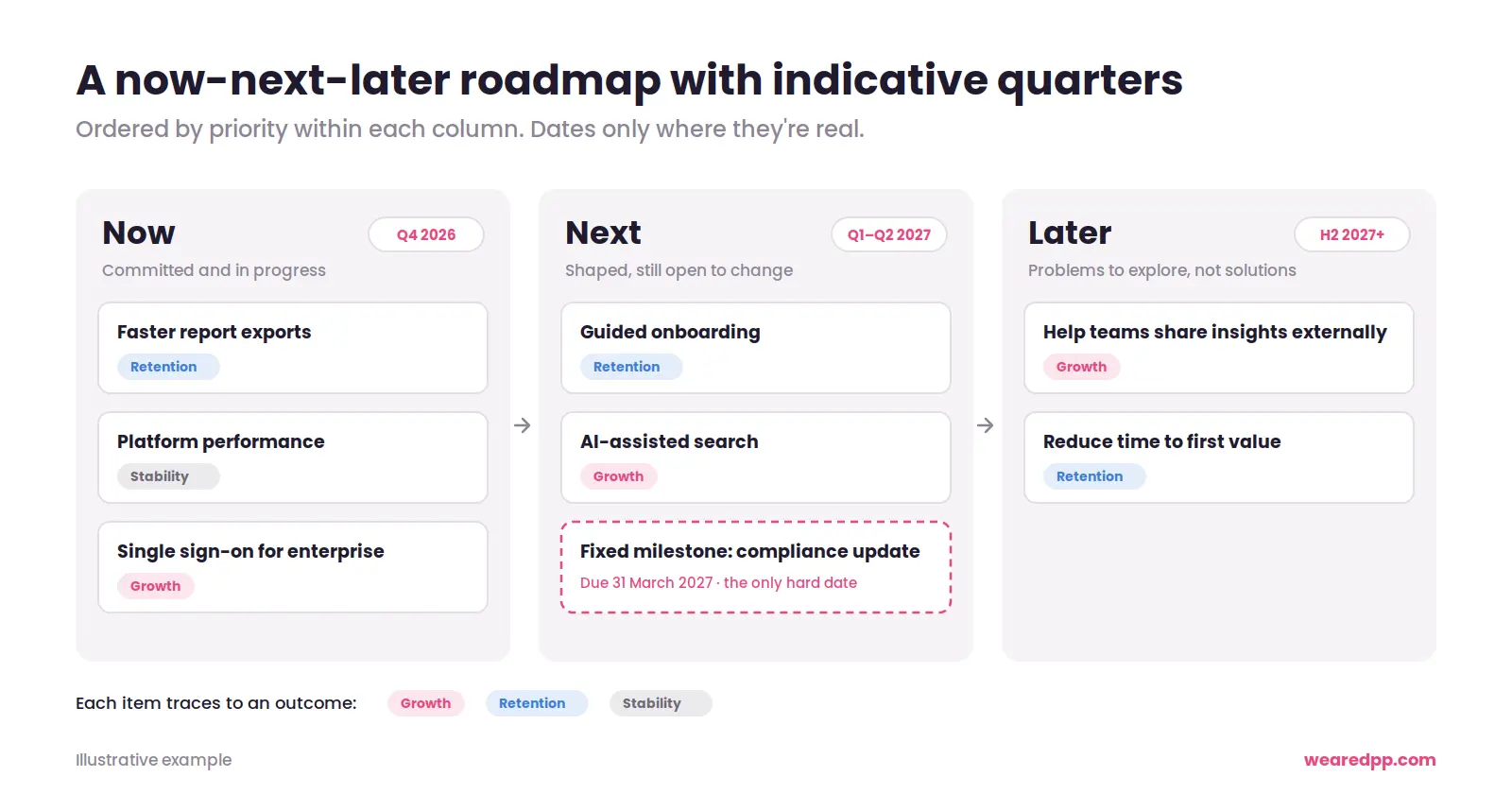
A now-next-later roadmap groups work into three horizons based on certainty rather than calendar dates. It answers a different question: "What matters most, and what comes after that?"
The format came out of ProdPad, devised by its co-founders Janna Bastow and Simon Cast. Bastow, who also co-founded Mind the Product, is widely credited as its inventor, and she makes the case against Gantt-style roadmaps well on Lenny's Podcast. ProdPad's guide to the trouble with traditional timeline roadmaps goes deeper. The format has three horizons:
- Now: what the team is working on. It's well defined and committed.
- Next: the priorities queued up. They're shaped but still open to change.
- Later: the direction of travel. The problems are understood, but the solutions aren't yet.
The difference isn't cosmetic. One format is built around delivery dates. The other is built around priorities and learning.
Why timeline roadmaps lose trust
The moment you put a date against a feature and show it to a board, you've stepped into the firing line. That date stops being an estimate and becomes a promise. In B2B product work, promises made months out rarely survive contact with reality.
What happens next usually goes like this:
- The date slips, because discovery turned up something nobody expected.
- The board remembers the date, not the reasons.
- The team starts protecting deadlines instead of outcomes, and quietly stops learning.
That last one is the real cost. A timeline leaves no room to learn and adapt as you go. Say user research shows a feature should look completely different. A timeline makes changing course feel like failure, when it's actually good product management, and teams under that pressure pay the hidden cost of speed. We've written more about this in why product roadmaps look good but don't work.
Even Monzo, famous for its transparent roadmap, ran into this. Its early public board grouped work into horizons with rough timeframes, such as "next 6–9 months". One customer on Monzo's community forum did the maths a year later: the 6–9 months started in July 2016, and it was nearly July 2017. A Monzo team member later admitted that keeping the roadmap up to date with realistic timelines was "a bit of a mess". Even a loose timeframe gets read as a promise.
Why a now-next-later roadmap works better for B2B product teams
Now-next-later lets work take the time it actually needs. It also lets you reprioritise as things get closer. An item sitting in "later" gets sharper and better understood by the time it reaches "next". That makes it a natural fit for teams that run experiments without slowing delivery.
You'll see the pattern at serious scale. Slack ran its developer platform roadmap on a public Trello board, with near term, mid term, long term and ongoing columns, as Trello's own blog showcased. That's now-next-later in all but name.
.webp)
That doesn't mean abandoning time altogether. In our experience, the strongest now-next-later roadmaps include two extra layers.
Indicative prioritisation
Within each column, order matters. The top of "next" is what the team picks up first. It's a signal, not a contract. It's also where a clear prioritisation framework earns its keep.
Indicative timeframes
A quarter is usually the right level of precision. "We're aiming for Q2" gives sales, customer success and the board something to plan around, without pinning your team to a specific Tuesday in May. ProdPad suggests the same: quarters are a useful bridge for teams weaning themselves off timeline roadmaps, and its guide to converting a timeline roadmap to now-next-later walks through the switch. Be honest about timing. Just don't set yourself up for failure.
What customers really want from your product roadmap
Product teams often underestimate this: customers care less about when something will ship than whether it will ship at all.
I learnt this as a customer. I used Zoho One and kept waiting for the product update that would fix the things frustrating me. It never came, and nobody told me whether it ever would. So I left for Copper, the snazzier alternative.
I'm not alone. One Zoho CRM user, posting on Zoho's own community forum, wrote: "I can live with a continuously evolving product". Their condition was simply knowing how and when it would change. They'd already been told to evaluate alternatives. People don't leave because of today's experience. They leave because they've lost faith that it will get better.

That's a roadmap communication problem as much as a product problem. Customers don't need a date for everything. They need answers to three questions:
- Is the thing I care about actually happening?
- Where does it sit in your priorities?
- Can I have a say in how it turns out?
Monzo understood this early. In 2016 it launched a transparent product roadmap on Trello, showing customers what was being built and what was coming next, and letting them vote. In 2018, it replaced the board with its own Making Monzo roadmap, where customers could follow features and join the discussion. I loved it. It made me feel like an insider, part of the club.
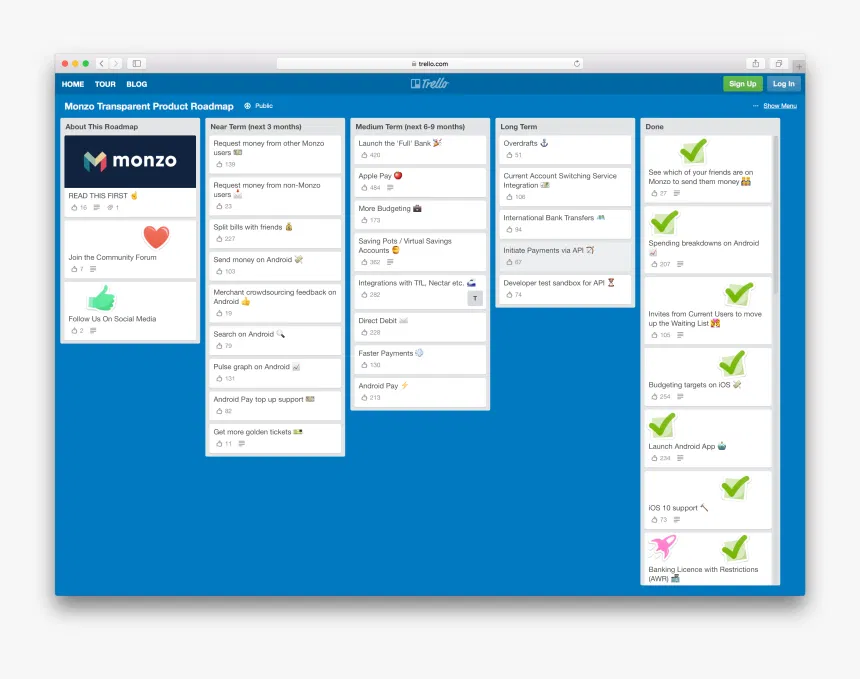
Public roadmaps need care, though. Trello found that the power users most active on its own public roadmap weren't always its highest-priority users, so it shifted the board to show what had shipped and explained the future in curated posts instead. Share direction and priorities. Keep the detail for conversations.
B2B products can go further. If a feature is your next priority, invite the customers who asked for it into user testing. They see it first, you get feedback from the people who'll actually use it, and a frustrated customer becomes an advocate. It's one of the cheapest retention tactics going.
How to present a now-next-later roadmap to your board
Boards care about the bottom line: revenue, growth and risk. This is where a lot of well-built roadmaps fall apart. They get described in the language of the product team rather than the language of the business.
Picture it. You tell the board that "now" is tech debt. Then you tell them the AI feature they're excited about, the one they see as key to market differentiation, sits in "later". That's not going to fly. The problem isn't the prioritisation. It's the framing, and it's exactly the tension between short-term AI pressure and long-term product strategy.
Reframe every item as a business outcome
"Tech debt" is a rubbish term. It sounds like housekeeping, and it switches plenty of CEOs off. Instead, say what the work protects: faster delivery, fewer incidents, lower cost to serve, and the ability to ship that AI feature safely.
Every item on the roadmap should trace back to the business outcome it drives, and to a meaningful metric rather than a vanity one. If you can't name the outcome, question whether the item belongs there. For more on this, read design debt, tech debt or trust debt? and outcome over output.
It also makes saying no easier. When the roadmap is framed around outcomes, you can say no to senior stakeholders without damaging relationships, because the conversation is about what moves the business, not whose idea wins.
Show how you're splitting effort
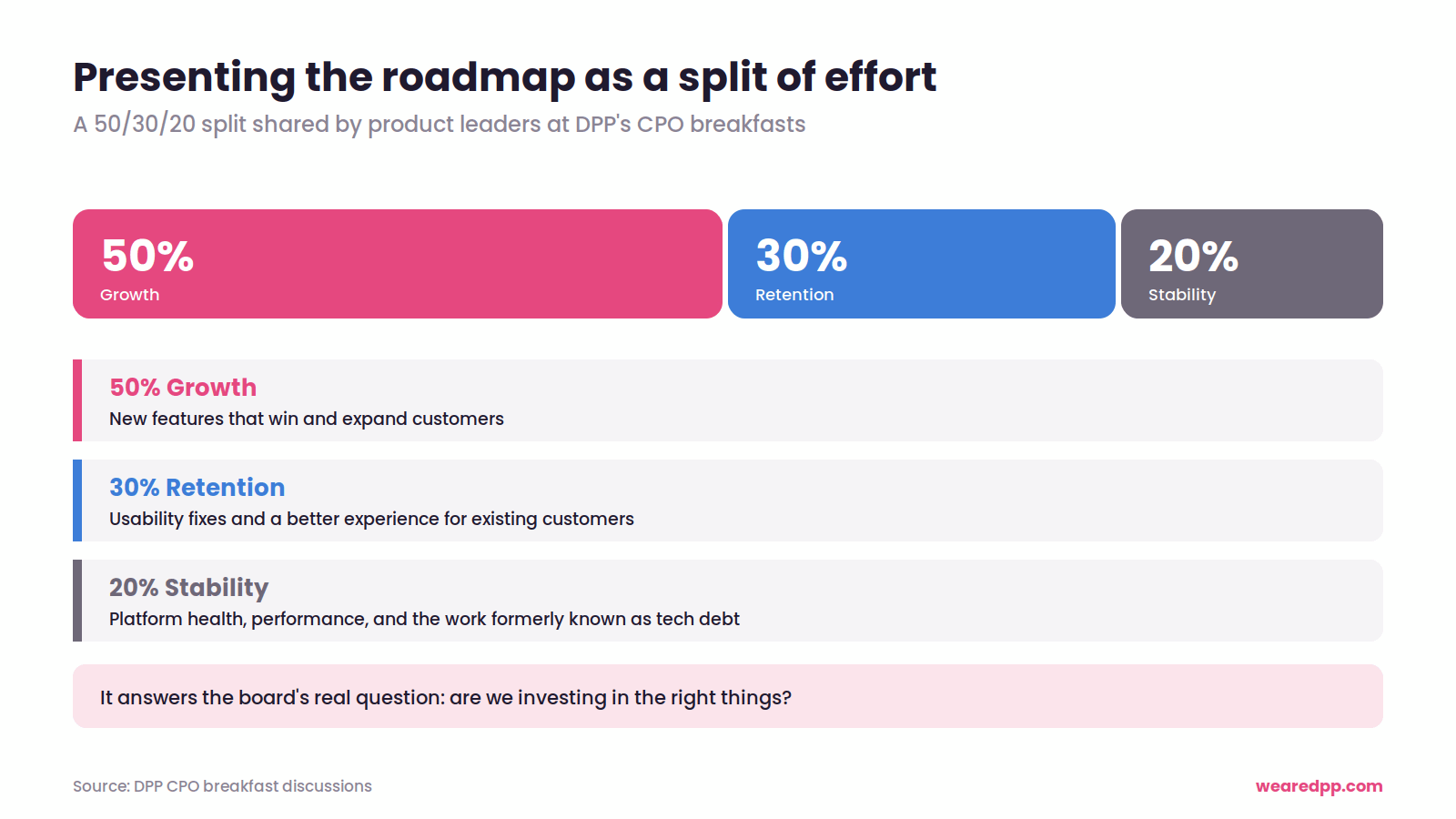
At our CPO breakfasts, we've heard product leaders change how they talk about the roadmap altogether. Instead of listing features, they describe it as percentages of effort. One split that came up was 50/30/20:
- 50% on growth: new features that win and expand customers.
- 30% on retention: fixing usability issues and improving the experience for existing customers.
- 20% on stability: platform health, performance, and the work formerly known as tech debt, including the UX debt no one budgets for.
This works because it answers the question boards are really asking: are we investing in the right things? It also gives you room to move individual items around without reopening the whole conversation, which helps you balance long-term strategy with short-term demands.
When a timeline roadmap still makes sense
Dates aren't evil. Some commitments genuinely need them, such as a regulatory deadline, a contractual promise to a major customer, or a launch tied to an industry event.
The trick is to treat these as fixed milestones inside your now-next-later roadmap, not as a reason to date everything. Bastow makes the same point on Lenny's Podcast: when a date is genuinely necessary, plan for it with buffer time and soft launches, rather than dating the whole roadmap. Date what's genuinely committed. Leave the rest to priorities and indicative quarters.
If your current roadmap has drifted into a wall of dates, a roadmap reset is a good place to start, followed by our roadmap planning best practices.
What this means for product leaders
- Swap dates for confidence. Commit to now, shape next, and explore later.
- Use quarters, not days. Indicative timeframes give people enough to plan around.
- Speak the board's language. Every item should trace to revenue, retention or risk.
- Show the split. Percentages of effort answer "are we investing in the right things?"
- Keep customers in the loop. Tell them what's happening and invite them to help shape it.
- Date only what's real. Fixed deadlines become milestones, not the whole roadmap.
Final thought
Timeline roadmaps feel reassuring because they look certain. But certainty you can't deliver is worse than honesty you can. A now-next-later roadmap does more for everyone when it's backed by indicative timeframes and framed around business outcomes. Your board gets confidence, your customers get reassurance, and your team gets room to learn. The dates matter less than people think. Transparency matters more.
Struggling to build a roadmap your board trusts and your team can actually deliver?
We help B2B product leaders connect product priorities to clear business outcomes, so everyone can see where the product is heading and why.
👉 Book a call with our team to talk about how we can help.
Are you wondering...
A now-next-later roadmap is a product roadmap format that groups work into three horizons based on certainty rather than dates. "Now" is committed work in progress, "next" is shaped priorities coming up, and "later" is the longer-term direction. ProdPad co-founders Janna Bastow and Simon Cast created it as an alternative to Gantt-style timelines.
A timeline roadmap plots features against specific dates and focuses on when things will ship. A now-next-later roadmap orders work by priority and certainty, focusing on what matters most and what comes next. Timelines suit fixed commitments. Now-next-later suits teams that need to learn, adapt and reprioritise as they go.
Not specific dates, but indicative timeframes help. Aiming for a quarter, such as "Q2", gives sales, customer success and the board enough to plan around without locking the team into a promise it may not keep. Keep firm dates for genuine milestones, like regulatory deadlines or contractual commitments.
Timeline roadmaps turn estimates into promises. When dates slip, which they usually do, trust with the board and customers erodes. Timelines also discourage learning, because changing course based on user research feels like failure. Now-next-later keeps teams accountable to priorities and outcomes rather than arbitrary deadlines.
Frame every item around the business outcome it drives, such as revenue growth, retention or reduced risk. Avoid internal jargon like "tech debt" and explain what the work protects. Some product leaders present effort as percentages, for example 50% growth, 30% retention and 20% stability, to show the board where investment is going.
Yes, and they work well together. OKRs set the outcomes you want, and the now-next-later roadmap shows the bets you are making to reach them. ProdPad, which created the format, recommends OKRs as the goal framework that fits it best. Each roadmap item should link to the objective it serves.
Use a timeline when the work is tied to a fixed external date, such as a regulatory deadline, a contractual commitment or a launch event. Even then, it's usually better to show these as fixed milestones within a now-next-later roadmap than to put dates against everything.
Yes, in a customer-friendly form. Customers mostly want to know whether the thing they care about is happening and where it sits in your priorities. Sharing a high-level roadmap builds trust and reduces churn. Inviting customers into user testing for upcoming features builds loyalty even further.
A 50/30/20 split is a way of presenting a product roadmap as percentages of team effort. It allocates 50% to growth through new features, 30% to retention through usability and experience improvements, and 20% to stability, such as platform health and technical debt. It helps boards see investment balance at a glance.
You'll know your now-next-later roadmap is working when:
✅ Board conversations focus on outcomes and investment balance, not missed dates
✅ Items move between columns without triggering a crisis
✅ Sales and customer success can plan confidently around indicative quarters
✅ Customers know what's coming next, and some are helping to test it
✅ Your team changes course based on research without it feeling like failure
More insights
.png)
PM, designer or product builder? How AI is reshaping product team roles
Need help delivering at pace whilst maintaining product integrity?
We help B2B product teams rebalance pace and purpose — designing workflows where speed serves strategy instead of undermining it. Book a call to talk about how we can help you deliver your product's vision.