IKEA's AI strategy: reinvesting savings, not cutting jobs

IKEA saved €13M by automating 47% of customer service with AI — then reinvested it into staff, generating €1.3B in extra revenue. Here's how.
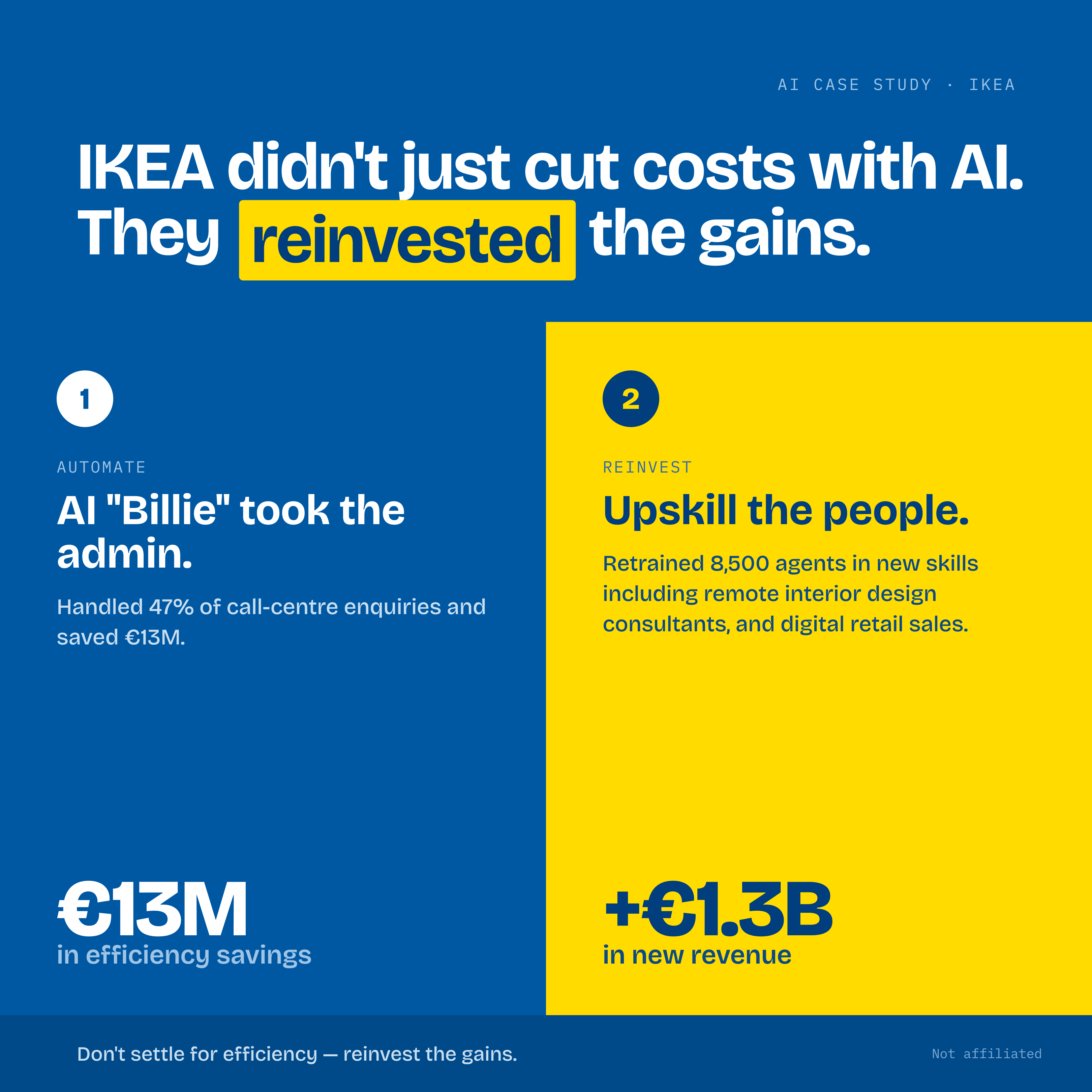
IKEA Didn't Just Cut Costs With AI — It Reinvested the Gains Into €1.3B in Revenue
IKEA used an AI assistant called Billie to automate 47% of customer service enquiries, saving €13M. Instead of cutting staff, IKEA retrained roughly 8,500 call centre employees as remote interior design consultants and digital sales advisors — turning an efficiency gain into €1.3B in additional revenue.
Most companies treat AI as a cost-cutting tool. IKEA used it as a starting point for reinvestment — and the result is one of the clearest public case studies of AI driving revenue growth rather than headcount reduction.
What problem was IKEA solving?
IKEA's call centres were overwhelmed with enquiries ranging from delivery updates and refund requests to tailored interior design help. The volume made it hard to give every customer the attention they needed.
How did IKEA use AI to cut costs?
IKEA deployed an AI assistant, Billie, to handle routine, high-volume enquiries. Billie resolved 47% of all customer enquiries, saving the company €13 million. On its own, this is a straightforward automation win — the kind most businesses stop at.
Why didn't IKEA cut staff after automating 47% of enquiries?
Because the remaining 53% of enquiries revealed something more valuable: a large volume of customers actively asking for interior design help. Rather than treating this as overflow, IKEA treated it as a growth signal hidden in their own customer data.
What did IKEA do instead?
IKEA retrained approximately 8,500 call centre employees into new, higher-value roles, including:
- Remote interior design consultants
- Digital retail sales advisors
Billie continued handling administrative and repetitive queries, freeing employees to focus on the design and sales conversations customers were already asking for.
What was the result?
The reinvestment produced three outcomes at once: more value for customers, job security for employees, and significant new revenue for the business.
- Outcome Detail Cost savings from AI: €13M
- Additional revenue generated: €1.3B
- Employees retrained: ~8,500
- Enquiries automated 47%
3 takeaways for applying this to your own AI strategy
- Don't stop at efficiency — reinvest the gains. Cost savings from AI are a starting point, not the finish line.
- Study what AI doesn't handle. The unresolved 53% of enquiries held more insight than the automated 47%.
- Define what success looks like before you start. Clear metrics are what let a team tell a story like this one afterward — track revenue and retention impact, not just efficiency.
Are you wondering...
AI can significantly accelerate design exploration, prototyping, engineering workflows and product analytics. By shortening the feedback loop between design, engineering and product teams, AI can help organisations learn faster and improve products more quickly.
Track metrics like user satisfaction, support tickets referencing wrong answers, and time to correction. Qualitative research (e.g. user interviews or usability testing) can also reveal whether people feel confident and informed when using AI features.
AI requires both exploration and direction. Businesses need to experiment to understand what’s possible, but that experimentation should be grounded in a clear understanding of the problem and what success looks like. Without that, activity becomes disconnected from strategy.
More insights
.png)
PM, designer or product builder? How AI is reshaping product team roles
Need help delivering at pace whilst maintaining product integrity?
We help B2B product teams rebalance pace and purpose — designing workflows where speed serves strategy instead of undermining it. Book a call to talk about how we can help you deliver your product's vision.