How to choose a UX design agency for a B2B product (and what to ask before you sign)

How to choose a UX design agency for your B2B product: what to look for, the red flags to avoid and the questions to ask before you sign.
Choosing a UX design agency looks simple on paper and gets complicated fast. Everyone has a polished deck, a list of logos and a confident pitch. Very little of that tells you how the partnership will feel in month three, when the pressure is on and the real decisions are being made.
The short answer: to choose a UX design agency for a B2B product, start with the outcome you need, then judge agencies on how they work. Look for an adaptable process, real user research, a senior lead who stays involved, and a willingness to let you speak to any of their clients.
This guide covers what to look for, the red flags worth taking seriously, and the questions to ask at every stage of the conversation. It's written for B2B product leaders, but the principles apply to any complex digital product.
Start with the problem, not the shortlist
The best briefs start with a problem, not a list of deliverables. Before you speak to anyone, get clear on three things:
- The outcome you need. Faster onboarding, fewer support tickets, higher adoption, or a platform that finally feels coherent.
- What you already know. Analytics, customer feedback, sales objections, anything that shows where the product struggles.
- Who needs to be on board. Stakeholders who will shape or challenge the work are better involved early than surprised late.
Here's the difference in practice. "Redesign the dashboard" is a deliverable. "Account managers take 20 minutes to find which clients need attention, and we want that under five" is a problem an agency can get its teeth into.
You won't have all the answers, and a good agency will help you find the rest. If you're not sure where the problem sits, a UX audit is often a sensible first step.

Does the agency need experience in your industry?
This is the question buyers lean on most, and it's often given too much weight. Industry experience helps, but it isn't the be-all and end-all, because the roles are different. You're the subject matter experts. A UX agency's expertise is taking complex problems and making them simple, familiar and usable for people who aren't experts in the product. We've written about how to simplify complex products without dumbing them down.
That familiarity matters. Jakob's Law says users spend most of their time on other products, so they expect yours to work the way those do. Good UX draws on established principles and consistent design patterns, which is why those skills transfer from one industry to the next.
Where specialist experience genuinely earns its place is in specific challenges:
- Data-heavy products. Knowing why simply showing someone a graph rarely helps, and how dashboards and search in data-heavy products can support decisions.
- Complex workflows. Multi-step, multi-role processes where one wrong turn is costly, and where complexity carries hidden costs.
- Particular user needs. B2B users are rarely focused on just one thing. They're multitasking, switching between tools and chasing a specific objective, often against the clock. Designing for that, and balancing multiple personas, is experience worth asking about.
So instead of asking "have you worked in our sector?", ask "have you solved problems like ours?" In B2B the answer is usually yes. The same problems come up again and again, and "the interface is difficult to use" sounds remarkably similar wherever you are.
What to look for in how an agency works
Beyond the portfolio, these are the signs of an agency that will do good work with you, not just for you.
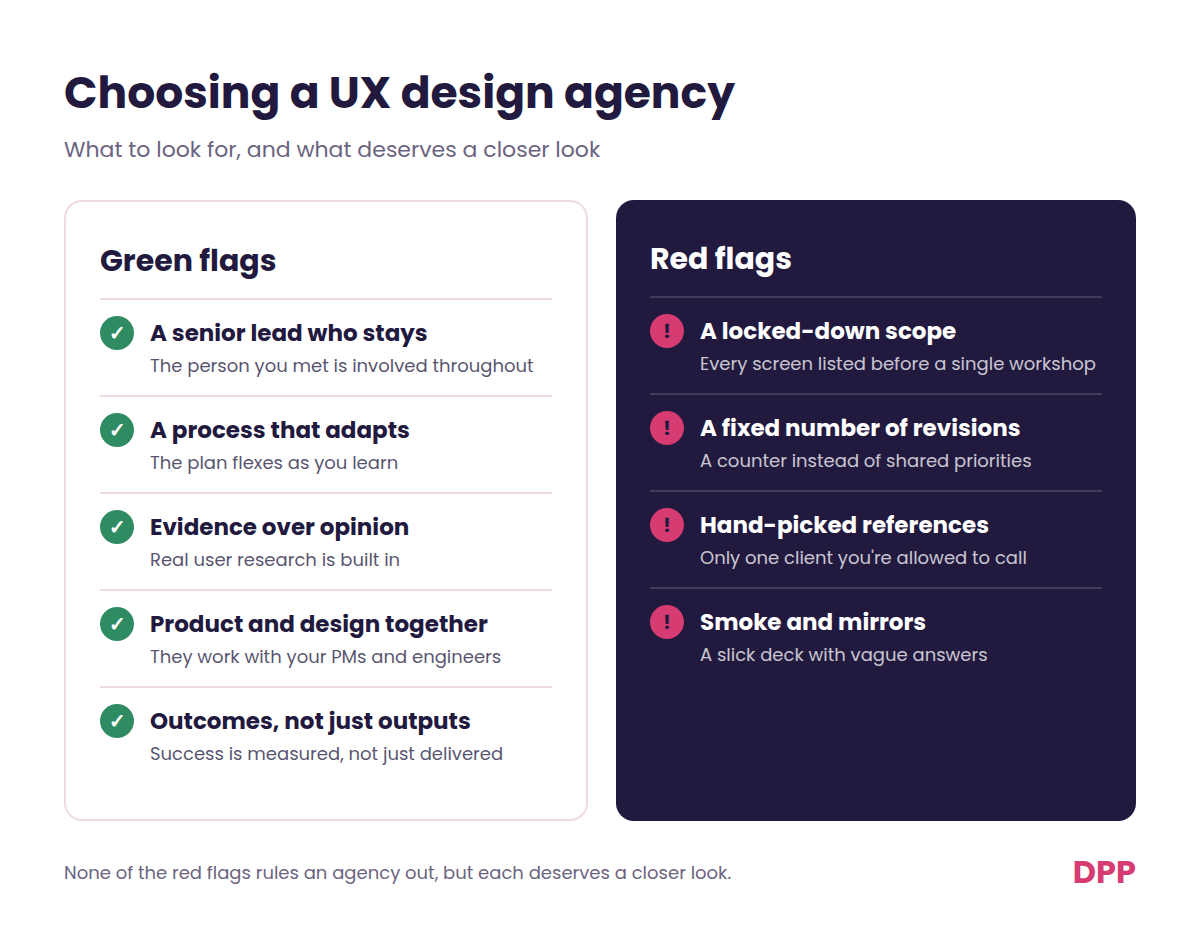
- A senior lead who stays. You're not hiring an individual, you're hiring an agency that's accountable for delivering quality. Different skills will come in at different stages, and that's fine. What matters is that the senior person you've been dealing with stays involved, because they understand your problem, bring in the right team and make sure the work hits your objectives.
- A process that adapts. Good agencies have a clear way of working, but they don't pretend to know everything on day one. The kickoff, workshops and product discovery are where the real learning happens, so the plan should flex as you go.
- Evidence over opinion. Look for real user research built into the process, not design based on assumptions. Ask how they will get access to your users, and how they mix research methods.
- Product and design working together. The two shouldn't work in silos. Ask how the agency will work alongside your product managers and engineers, and whether they genuinely listen. It's the same principle as aligning design and engineering inside your own team.
- Outcomes, not just outputs. Pages delivered is an output. Faster task completion, better adoption or lower churn are outcomes. Ask how success will be measured, and look for an agency that talks about outcome over output.
Red flags to watch for, whoever you hire
None of these automatically rules an agency out, but each deserves a closer look.
- A long, locked-down scope of work. A page-by-page list of everything that will be delivered, agreed before anyone has run a workshop, is a guess dressed up as a plan. "Thirty screens and two rounds of revisions" tells you nothing about whether the product will work better. You've barely scratched the surface at that point, and the flexibility to learn and adapt is where the best work comes from.
- A fixed number of revisions. Of course you can't iterate forever, but you also shouldn't go live with something you're not happy with. The best relationships run on clear prioritisation and flexibility from both sides, not a revision counter.
- Hand-picked references only. If an agency offers one specific client to speak to, ask about the others. One project may have gone brilliantly, but what about the rest? An agency that says "pick any client and we'll introduce you" is showing real confidence.
- Smoke and mirrors. Slick presentations are easy. Look for substance underneath: specific answers about process and past work.
Agency or in-house?
Hiring a designer can be the right call, but it depends on what sits around them. A single designer with nobody more senior to coach and challenge them is a risk. Who critiques their work against good design practice? Over time, with internal politics and every team treating them as a resource, even a confident hire can end up reacting to briefs instead of shaping the product. That's often how UX debt creeps into a product.
We're often brought in a year after exactly this. It's rarely the designer's fault. They simply weren't set up in an environment that helped them develop.

A team is a different proposition:
- A range of experience, from junior to senior.
- Built-in review, so quality doesn't rest on one person.
- People who challenge each other and raise the standard of the work.
- More capacity to get things done.
- Systems and a vision that others can pick up and run with.
Our view: hire in-house when you can build a team, not before. In between there's a middle path. An agency can set up the systems and vision, then stay on for a couple of days a month to critique the work and act as a sounding board for your in-house designer, with the context already in place. We've written more on when outsourcing product design is the right move.
Questions to ask a UX agency at every stage
The right questions change as the conversation moves on. Here's what to ask at the beginning, in the middle and before you sign.
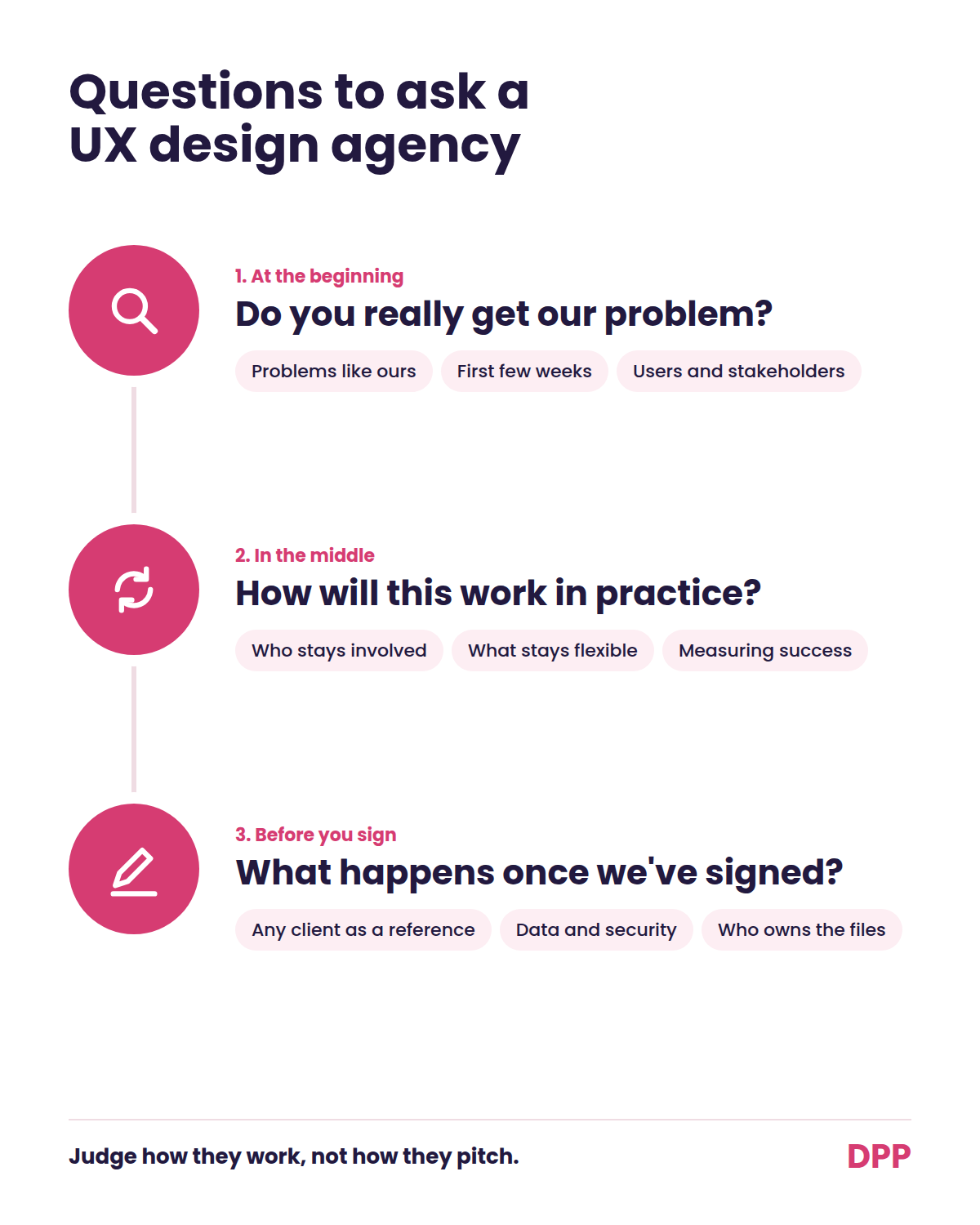
Questions to ask a UX design agency at the beginning, in the middle and before you sign:
At the beginning
You're working out whether this agency really understands your problem.
- What would you need to understand about our problem before you could say whether you're the right fit?
- Have you solved problems like ours, and what did you learn?
- How would you approach the first few weeks?
- How would you involve our users, stakeholders and engineers?
In the middle
You've heard their approach. Now test how it will work in practice.
- Will the person we've been speaking to stay involved throughout?
- What stays flexible once discovery begins, and how do you handle changing priorities?
- How will you measure whether the work has made a difference?
- How do you use AI in your process, and how is the quality checked? (AI can speed up analysis, but it makes expertise more important, not less.)
Before you sign
You're close to a decision. Check the details that matter once the work is under way.
- Can we speak to any of your clients, not just one you choose?
- How do you handle our data, NDAs and security requirements?
- How do you design to accessibility standards such as WCAG? (More on designing for accessibility.)
- What happens when we disagree?
- Who owns the files and any design system, and what happens after the project ends?
What a good agency relationship looks like three months in
Every new working relationship, whether it's an agency, a new hire or a reshuffled team, follows a familiar pattern. Tuckman's model calls it forming, storming, norming and performing. People start with good intentions and plenty of agreement. Then the stakes rise, stress builds and misalignment appears. That's normal, not a warning sign. In fact, a little friction is good for a product team.
What matters is how you handle those moments. Three months in, a healthy relationship tends to look like this:
- Worries get raised early, even the small niggles, which only happens with psychological safety.
- Challenge is welcomed in both directions.
- Everyone knows what's going on, with open, transparent communication.
- Disagreements make the work better instead of derailing it.

Final thought
The best UX agency isn't the one with the slickest deck or the longest list of logos in your sector. It's the one that understands your problem, is open about how it works, flexes as it learns and is comfortable being challenged. Choose a partner you can have honest conversations with, because the next few months will depend on it.
Not sure whether a UX agency, an in-house hire or a mix of both is right for your product?
We're a UX/UI design agency that helps B2B product teams find the right model for where they are, and you're welcome to speak to any of our clients first.
👉 Book a call with our team to talk about how we can help.
Are you wondering...
Start with the outcome you need, then judge agencies on how they work: an adaptable process, real user research, a senior lead who stays involved, and a willingness to let you speak to any of their clients. Industry logos matter less than experience with problems like yours.
Not necessarily. Good UX follows established principles and patterns that work across industries, and B2B products tend to share the same core problems. Specialist experience helps most with data-heavy products, complex workflows and the needs of multitasking B2B users, so ask whether they've solved problems like yours.
Ask at each stage. At the start, what they need to understand about your problem and how they'd approach it. In the middle, whether the senior lead stays involved, what stays flexible and how success is measured. Before signing, whether you can speak to any client, and how they handle security, accessibility and life after the project.
Watch for a long, locked-down scope of work agreed before any discovery, a fixed number of revisions, and hand-picked references only. Polished presentations with vague answers about process and past work are another warning sign. None of these rules an agency out automatically, but each deserves a closer look before you sign.
Hire in-house when you can build a team with senior oversight. A lone designer with nobody to coach or challenge them often ends up reacting to briefs. Until then, an agency can set up the systems and vision, then stay on part-time to critique the work and support your hire.
Rarely in full. Most of what you need to know only emerges in kickoff, workshops and stakeholder conversations, so a page-by-page scope agreed on day one is mostly guesswork. The best plans agree the outcome, budget and way of working upfront, then stay flexible, with clear prioritisation on both sides.
Expect some friction as the stakes rise. It's a normal stage in any new team, not a warning sign. A healthy relationship has concerns raised early, challenge welcomed in both directions and open, transparent communication, so that disagreements improve the work instead of derailing it.
Lead with the problem and the outcome you need, not a list of deliverables. Add what you already know, such as analytics, customer feedback and sales objections, plus who your users are, which stakeholders need to be involved, your timeline and budget range. A good agency will help you fill the gaps.
Not necessarily. Location matters less than how an agency works and whether it has solved problems like yours. Being nearby does help with in-person workshops and user research sessions early on, so if you're London-based, ask how often the team will be in the room with you and your users.
You've chosen well when the relationship feels honest and the work moves your product forward. Look for these signals:
✅ The senior lead you met in the pitch is still involved
✅ The plan has changed since kickoff, for good reasons you understood
✅ Real users have been involved in the work
✅ Concerns get raised early, in both directions
✅ You can point to an outcome that's moving, not just screens delivered
Slug: how-do-we-know-weve-chosen-the-right-ux-agency (new)
The London FAQ is worth checking against how DPP actually works (in person, hybrid or remote) before it goes live.
More insights
.png)
PM, designer or product builder? How AI is reshaping product team roles
Need help delivering at pace whilst maintaining product integrity?
We help B2B product teams rebalance pace and purpose — designing workflows where speed serves strategy instead of undermining it. Book a call to talk about how we can help you deliver your product's vision.